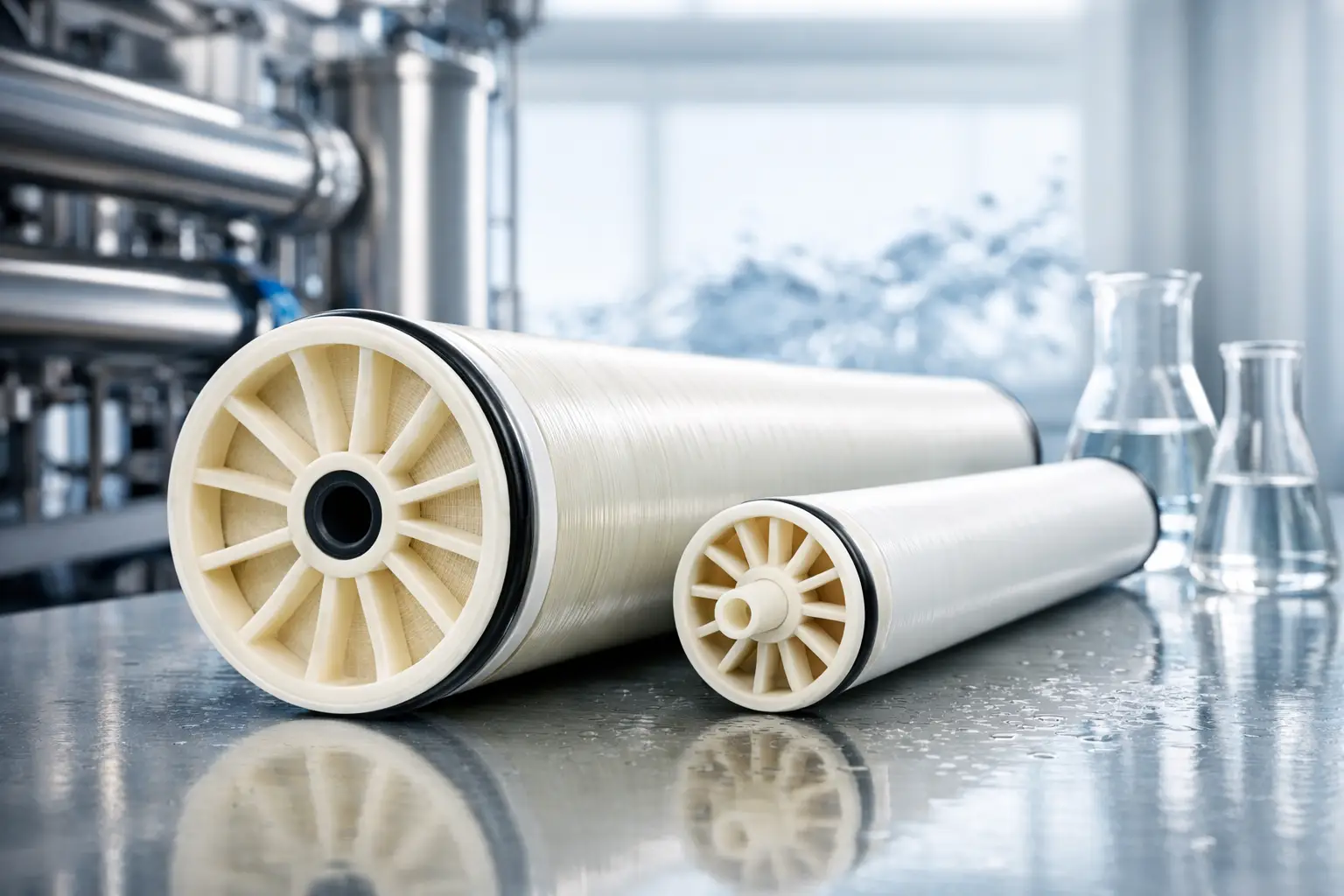
What an Aquaporin RO Membrane Actually Is
Aquaporin membrane technology takes a fundamentally different approach to filtration — one rooted in how living organisms have moved water for billions of years.
Municipal water arrives at your tap having traveled through miles of infrastructure, treated with chlorine, chloramines, and fluoride, and stripped of the natural spiral movement that gives water its biological coherence. A standard reverse osmosis membrane removes contaminants by forcing water through a semi-permeable barrier under pressure — effective, but mechanically blunt. Aquaporin membrane technology takes a fundamentally different approach, one rooted in how living organisms have moved water for billions of years.
Aquaporins are protein channels found in nearly every living cell. In the human body, they govern how water crosses cell membranes with extraordinary selectivity and speed — filtering water molecules while blocking dissolved solutes, bacteria, and viruses at a molecular scale. Researchers observed that biological systems use aquaporin channels to transport water at rates that synthetic membranes struggle to match, which prompted engineers to embed these proteins directly into thin-film composite membranes.
The result is a 4040-format RO membrane — 4 inches in diameter, 40 inches in length — that combines the mechanical framework of conventional reverse osmosis with the selective permeability of living tissue. The aquaporin proteins are incorporated into a lipid bilayer or polymer matrix, creating a surface that mimics the kidney’s filtration architecture rather than simply opposing it with brute hydraulic pressure.
What this means in practice:
- Higher water flux at lower operating pressures, reducing energy demand across the system
- Greater selectivity, allowing water molecules through while rejecting a broad spectrum of dissolved contaminants
- Biomimetic precision at the membrane surface, informed by the same phi-ratio geometry that governs natural water movement
This is precisely the principle that guides Waterheart’s design philosophy. Where aquaporin membranes restructure water at the filtration stage, The Heart — a passive 316L stainless steel vortex chamber — restores the natural spiral movement that pressurised treatment removes entirely.
How to Install and Commission a Commercial RO Membrane 4040
Understanding what an aquaporin RO membrane is only gets you so far. The real value comes from putting it to work correctly. Follow these steps to install a commercial RO membrane 4040 element, whether you’re upgrading an existing setup or building from scratch.
-
Verify your housing dimensions before anything else. A 4040 membrane measures 4 inches in diameter and 40 inches in length. Confirm your pressure vessel is rated for this format and that your inlet pressure falls within the manufacturer’s specified operating range — typically 40–80 PSI for residential-grade elements, higher for industrial configurations.
-
Inspect the membrane element for shipping damage. Remove the element from its sealed packaging carefully. Check the brine seal and product tube end cap for cracks or deformation. A compromised brine seal will allow feed water to bypass the membrane surface entirely, collapsing rejection performance.
-
Lubricate the o-rings with clean water or food-grade glycerin. Never use petroleum-based lubricants — they degrade elastomers over time. Slide the membrane element into the pressure vessel with the brine seal oriented toward the feed-water inlet end.
-
Hand-tighten end caps and connect feed, permeate, and concentrate lines. Confirm flow direction against the vessel’s port markings. Incorrect plumbing is one of the most common — and easily avoided — commissioning errors.
-
Flush the system for a full 30–60 minutes before collecting product water. New membrane elements contain a preservative solution. Route the initial permeate to drain. Monitor conductivity or TDS until readings stabilise — this confirms the membrane’s active layer is fully hydrated and operating as intended.
-
Log your baseline rejection rate. Measure feed TDS and permeate TDS simultaneously. Divide permeate TDS by feed TDS, subtract from 1, and multiply by 100. A healthy aquaporin-based element should demonstrate rejection rates above 97% under stable operating conditions.
Why Biomimetic Membrane Design Matters
Once your industrial RO membrane 4040 is installed and running, it’s worth pausing to understand why the aquaporin approach performs differently from conventional polyamide membranes — because the distinction isn’t cosmetic. It goes back to a fundamental principle: nature has already solved the problem of selective water transport.
Aquaporin proteins are biological water channels found in virtually every living organism. They allow water molecules to pass in single file while blocking contaminants with extraordinary precision. Aquaporin-based membranes literally embed these proteins into a synthetic matrix, replicating a filtration mechanism that biology refined over millions of years. The result is a membrane that works with water’s natural movement rather than forcing it through a purely mechanical barrier.
Here’s what that means in practical terms:
-
Recognise the energy difference. Conventional RO membranes rely on high pressure to overcome osmotic resistance. Biomimetic channels reduce that resistance at the molecular level, meaning less energy is required to achieve comparable or superior rejection rates.
-
Understand selectivity. Aquaporin channels are inherently selective — water passes freely while dissolved salts, chloramines, and organic contaminants are excluded. This selectivity is structural, not dependent on pore size alone.
-
Appreciate fouling resistance. Because the transport mechanism is embedded within a dense protein layer, biomimetic membranes tend to resist biological fouling better than traditional alternatives. This translates to longer effective service intervals.
-
Connect the principle to water quality. From a holistic water science perspective, membranes that mimic biological processes produce permeate that’s structurally closer to how water behaves in living systems — a foundation worth building on.
-
Factor in system longevity. Lower operating pressures and reduced fouling extend membrane lifespan — fewer replacements, less material waste.
Biomimetic engineering applied to membrane filtration isn’t abstract philosophy. It’s a measurable design choice with downstream effects on energy consumption, maintenance cycles, and permeate quality.
Where the 4040 Format Makes Sense
Choosing the right membrane housing size is as important as choosing the right membrane chemistry. Fitting the best 4040 RO membrane into the wrong application wastes both capital and water.
-
Confirm your flow demand. The 4040 element targets mid-range flow applications. It’s well-suited to light commercial use, multi-unit residential buildings, or whole-house systems where a standard 2.5×40 element falls short but a large 8040 industrial train would be oversized and cost-prohibitive.
-
Check your available pressure. The 4040 format operates effectively within standard municipal supply pressure ranges. If your feed pressure sits consistently between 50–80 psi, the format is a practical fit. Systems with highly variable inlet pressure may require a booster pump regardless of element size.
-
Evaluate your footprint constraints. A 4040 housing is compact enough for equipment rooms in apartment buildings, small commercial kitchens, and wellness clinics. Map your available floor or wall space before committing to a multi-element array.
-
Assess your water chemistry. High-TDS feed water, elevated chloramine levels, or significant suspended solids all influence which 4040 membrane material is appropriate. Aquaporin-based 4040 membranes tend to excel in moderate-TDS municipal water where their biological channel selectivity offers genuine efficiency gains over conventional thin-film composites.
-
Calculate your waste ratio tolerance. The 4040 format typically produces a recovery rate in the range of 15–25% per single element pass, though system design and membrane selection affect this considerably. Understand your operational water costs before sizing the system.
-
Match element count to redundancy needs. Commercial and light-industrial installations often series two or three 4040 elements to hit target permeate quality. Plan your housing array with this in mind from the outset.
Applied correctly, the 4040 format hits a genuine sweet spot: meaningful throughput, manageable infrastructure, and compatibility with advanced membrane chemistries.
Performance Expectations and Trade-offs
Understanding where an aquaporin-based reverse osmosis membrane excels — and where it asks something of you in return — is the practical knowledge that separates a well-specified system from an underperforming one.
-
Establish your baseline rejection target first. Aquaporin membranes consistently achieve high solute rejection, with biological water channels selecting for water molecules with a precision that conventional thin-film composite elements can’t fully replicate. In practice, rejection rates above 99% for dissolved salts are achievable — but only when operating pressure, feed temperature, and recovery rate stay within the manufacturer’s specified window.
-
Account for the permeate-to-concentrate ratio honestly. Higher water recovery is one of the genuine performance gains aquaporin elements offer. However, pushing recovery above the recommended ceiling concentrates scaling ions faster, which can stress any membrane. Set your recovery rate conservatively during commissioning, then adjust upward only after reviewing concentrate chemistry.
-
Monitor flux, not just flow rate. Normalised permeate flux tells you whether performance is drifting due to fouling or compaction. A downward trend in flux at stable operating pressure is your earliest warning sign — catching it early allows a cleaning-in-place protocol before irreversible fouling sets in.
-
Match pre-treatment to the membrane’s sensitivity profile. Aquaporin elements respond poorly to chlorine exposure and particulate loading above 0.1 SDI units. Confirm your pre-treatment train — sediment filtration, carbon reduction, and anti-scalant dosing — is properly sized before the element ever sees pressurised feed water.
-
Respect temperature boundaries. Permeate flow increases with feed water temperature, which sounds favourable. However, operating above the rated maximum accelerates membrane degradation. In commercial or industrial installations where inlet temperature can fluctuate seasonally, a temperature gauge upstream of the element housing is a straightforward safeguard.
-
Document a performance baseline within the first 30 days. Record pressure differential, permeate conductivity, and flow rate during initial stable operation. These figures become your reference point for every future performance check, letting you distinguish normal ageing from a problem worth investigating.
One honest trade-off worth naming: aquaporin membranes typically carry a higher upfront cost than standard elements. That gap narrows over time through lower energy consumption and extended service life — but it requires disciplined system management to realise.
What Industrial Buyers Should Check Before Specifying One
Specifying an aquaporin reverse osmosis membrane at industrial scale involves more than confirming a flux rating on a datasheet. These are the practical checkpoints that separate a confident specification from a costly mismatch.
-
Confirm feed water compatibility first. Aquaporin-based membranes integrate biological protein channels into a thin-film composite layer. Map your feed water chemistry — pH range, chlorine exposure, temperature, and suspended solids load. Aquaporin elements generally perform within a pH range of 3–10, but sustained oxidant exposure can degrade the active layer faster than conventional polyamide membranes. Know your pre-treatment baseline before committing.
-
Verify the 4040 element fits your existing pressure vessel. The 4040 designation means 4-inch diameter, 40-inch length — a widely adopted industrial standard. However, end-cap configurations, brine seal compatibility, and connector types vary across manufacturers. Cross-reference your current vessel specs before ordering.
-
Request the full normalised flux and rejection data under your operating conditions. Generic spec sheets often use idealised test parameters (typically 77°F, 250 psi, 2,000 ppm NaCl). Ask the supplier for performance curves at your actual feed pressure, temperature, and salinity. Protein-channel membranes can deliver higher permeability at lower driving pressures — a real operational advantage if your system runs at reduced pressure.
-
Evaluate the total cost of ownership, not just the unit price. Factor in energy savings from lower operating pressure, anticipated membrane lifespan, and replacement frequency. Reduced pumping demand often offsets a higher initial element cost within one to two operating cycles.
-
Assess supplier support and lead time from the point of origin. Industrial projects depend on reliable supply chains. Confirm the manufacturer’s distribution network, warranty terms, and technical support availability for your region.
-
Document your rejection requirements against regulatory thresholds. Whether you’re treating process water or potable supply, confirm that the element’s documented salt rejection and contaminant removal rates satisfy the applicable local or federal standards before finalising the specification.
Completing these checks before purchase gives your project a clear engineering foundation — and avoids the operational disruptions that surface when specifications are locked in without enough process data behind them.